Ribbon Seal Protection Sought by Activists

From: Dan Joling, AP via Discovery News

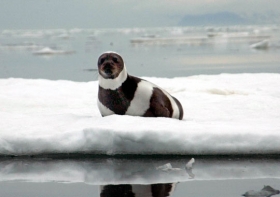
Ribbon seals should be listed as threatened or endangered because global warming is quickly melting sea ice, which the seals depend on for several months each year, two environmental groups said in a lawsuit filed against the federal government in San Francisco Thursday.

The National Oceanic and Atmospheric Administration in December denied a listing under the Endangered Species Act for the seals found off the coasts of Alaska and Russia.

The Center for Biological Diversity and Greenpeace sued in U.S. District Court, claiming the agency ignored the best science available on global warming.

Article continues

Climate-change technology risks 'catastrophic' outcome

Risky and unproven climate-changing technologies could have "catastrophic consequences" for the earth and humankind if used irresponsibly, according to a new report.

Yet without drastic further cuts in carbon dioxide emissions, a geoengineering solution may offer the only hope of saving the world from disastrous run-away global warming, experts warned.

A report by the Royal Society, Britain's leading academic institution, looks at the feasibility and potential dangers of technologies designed to cool the earth.

They include artificial "trees" that suck carbon dioxide out of the air, and spraying sulphate particles high in the atmosphere to scatter the sun's rays into space. The scientists concluded that, although some approaches were possible, they had not yet been properly researched and posed serious potential dangers for the planet.

Professor John Shepherd, who chaired the Royal Society geoengineering working group, said: "It is an unpalatable truth that unless we can succeed in greatly reducing carbon dioxide emissions we are heading for a very uncomfortable and challenging climate future, and geoengineering will be the only option left to limit further temperature increases."

"Our research found that some geoengineering techniques could have serious unintended and detrimental effects on many people and ecosystems — yet we are still failing to take the only action that will prevent us from having to rely on them."

Article continues: http://www.birminghampost.net/birmingham-business/birmingham-business-news/other-uk-business/2009/09/01/climate-change-technology-risks-catastrophic-outcome-report-65233-24585797/

Abrupt reversal detected in Arctic cooling trend

David Perlman, Chronicle Science Editor

The Arctic climate has been warmer over the past decade than during any 10-year period in 2,000 years, according to a study by an international research team that adds powerful new evidence that human-generated greenhouse gases have speeded the pace of the planet's recent warming.


The report from an international team of climate scientists concludes that climate change in the Arctic has accelerated since the Industrial Revolution, abruptly reversing a long-term worldwide cooling trend.

"The study provides a clear example of how increased greenhouse gases are now changing our climate," said Caspar Ammann of the National Center for Atmospheric Research in Boulder, Colo., a co-author of the report published Thursday in the journal Science.

To deduce the Arctic's decade-by-decade climate trend over the centuries, the leading scientists in the international study analyzed sediment cores in 14 Arctic lakes that revealed the varied growth rates of long-buried plants. They also studied Arctic tree rings to determine their growth rates and ages as well as ice cores from glaciers across the Arctic that showed patterns of relative warm and cold.

Researchers at other institutions, seeking to look for patterns of climate change even further back in time, used astronomical records to study the well-known wobble of the globe as it spins on its axis. They found that the Northern Hemisphere has long been moving away from the sun's warmth. During the summer solstice, the Northern Hemisphere is now a million kilometers - about 621,000 miles - farther away from the sun than it was 2,000 years ago, according to the scientist's computer models.

The result was a global period of relative cold that would have continued, the scientists found. But about 1850, at the beginning of the Industrial Age, the planet's climate began overcoming the cooling trend, and the Arctic climate has warmed decade by decade ever since as greenhouse gas emissions have increased, the scientists say.

Stephen Schneider, a Stanford climate expert and biologist who did not participate in the study, called the seven-year study, involving seven major research institutions in three nations, "a heroic effort."

The study, he said, "shows that nature has been, unfortunately, cooperating with theory and showing us on a long-time scale of millennia that the mainstream view is once again bolstered."

It is clear again, Schneider said, that anthropogenic influences - the increasing emission of greenhouse gases into the Earth's atmosphere - are the prime cause of global warming.


For the rest of the article go to:

http://www.sfgate.com/cgi-bin/article.cgi?f=/c/a/2009/09/04/MNB219HIRT.DTL&tsp=1
Vast expanses of Arctic ice melt in summer heat

From Japan Today

TUKTOYAKTUK, Northwest Territories —

The Arctic Ocean has given up tens of thousands more square kilometers of ice on Sunday in a relentless summer of melt, with scientists watching through satellite eyes for a possible record low polar ice cap.

From the barren Arctic shore of this village in Canada’s far northwest, 2,414 kilometers north of Seattle, veteran observer Eddie Gruben has seen the summer ice retreating more each decade as the world has warmed. By this weekend the ice edge lay some 128 kilometers at sea.

“Forty years ago, it was 40 miles (64 kilometers) out,” said Gruben, 89, patriarch of a local contracting business.

Global average temperatures rose 1 degree Fahrenheit (0.6 degree Celsius) in the past century, but Arctic temperatures rose twice as much or even faster, almost certainly in good part because of manmade greenhouse gases, researchers say.

In late July the mercury soared to almost 86 degrees Fahrenheit (30 degrees Celsius) in this settlement of 900 Inuvialuit, the name for western Arctic Eskimos.

“The water was really warm,” Gruben said. “The kids were swimming in the ocean.”

As of Thursday, the U.S. National Snow and Ice Data Center reported, the polar ice cap extended over 6.75 million square kilometers after having shrunk an average 106,000 square kilometers a day in July—equivalent to one Indiana or three Belgiums daily.

The rate of melt was similar to that of July 2007, the year when the ice cap dwindled to a record low minimum extent of 4.3 million square kilometers in September.

In its latest analysis, the Colorado-based NSIDC said Arctic atmospheric conditions this summer have been similar to those of the summer of 2007, including a high-pressure ridge that produced clear skies and strong melt in the Beaufort Sea, the arm of the Arctic Ocean off northern Alaska and northwestern Canada.

In July, “we saw acceleration in loss of ice,” the U.S. center’s Walt Meier told The Associated Press. In recent days the pace has slowed, making a record-breaking final minimum “less likely but still possible,” he said.

Scientists say the makeup of the frozen polar sea has shifted significantly the past few years, as thick multiyear ice has given way as the Arctic’s dominant form to thin ice that comes and goes with each winter and summer.

The past few years have “signaled a fundamental change in the character of the ice and the Arctic climate,” Meier said.

Ironically, the summer melts since 2007 appear to have allowed disintegrating but still thick multiyear ice to drift this year into the relatively narrow channels of the Northwest Passage, the east-west water route through Canada’s Arctic islands. Usually impassable channels had been relatively ice-free the past two summers.

“We need some warm temperatures with easterly or southeasterly winds to break up and move this ice to the north,” Mark Schrader, skipper of the sailboat Ocean Watch, e-mailed The Associated Press from the west entrance to the passage.

The steel-hulled sailboat, with scientists joining it at stops along the way, is on a 40,232-kilometer, foundation-financed circumnavigation of the Americas, to view and demonstrate the impact of climate change on the continents’ environments.

Environmentalists worry, for example, that the ice-dependent polar bear will struggle to survive as the Arctic cap melts. Schrader reported seeing only one bear, an animal chased from the Arctic shore of Barrow, Alaska, that “swam close to Ocean Watch on its way out to sea.”


(The rest of the article is available at: http://www.japantoday.com/category/world/view/vast-expanses-of-arctic-ice-melt-in-summer-heat)